Emergency Water Guide
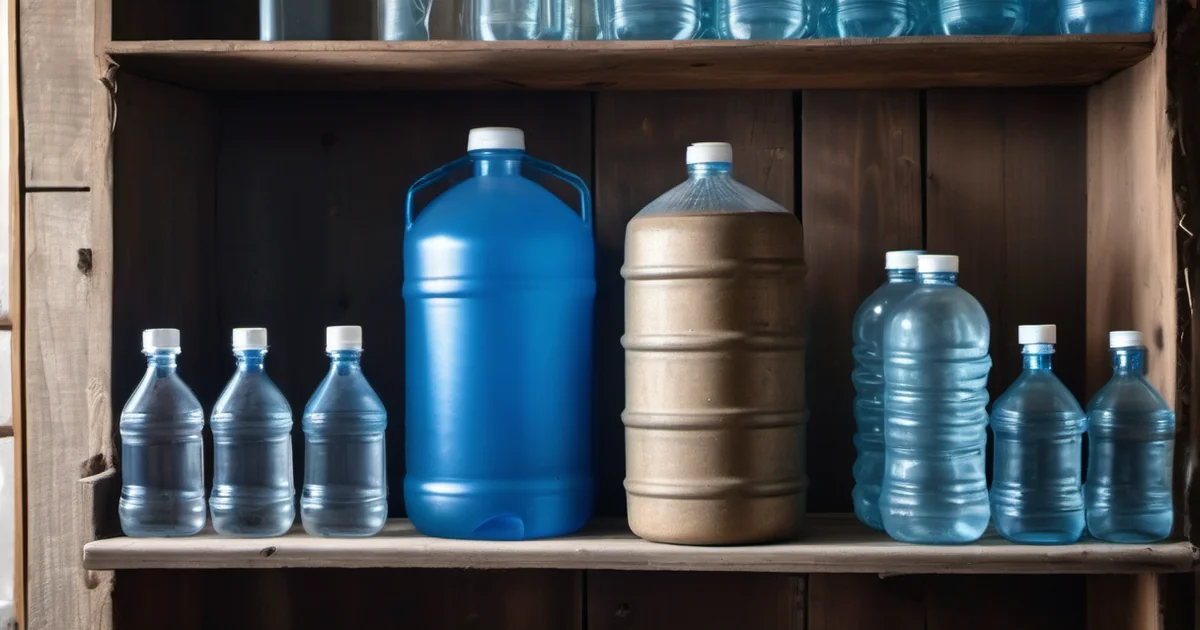
Water is the single most important resource in any emergency. You can survive weeks without food but only a few days without clean drinking water. The World Health Organization (WHO) sets a minimum of 2 litres per person per day for drinking, and Government of Canada's canada.ca/prepare campaign recommends storing enough to manage for at least 72 hours. In real-world Canada events like the Walkerton, Ontario outbreak (May 2000) and the flooding after Hurricane Fiona (2022) and the November 2021 BC floods, having several full days of stored water has proved invaluable.
Across Canada, storms, floods, and infrastructure failures regularly leave communities without safe drinking water for days. The Walkerton, Ontario outbreak in May 2000, when E. coli O157:H7 contaminated the town water supply, killed 7 people and sickened around 2,300 — the benchmark Canadian water-safety disaster. After Hurricane Fiona (2022) and the November 2021 BC floods, communities lost safe tap water for days. These are not hypothetical scenarios — they happen every year and affect households who never thought they were at risk.
How Much Water Do You Actually Need
The 2-litre-per-person-per-day figure from WHO is a drinking minimum. In practice, your needs depend on several factors:
- Heatwaves or physical activity: increases to 3 litres per person per day. During the June 2021 Western heat dome, Lytton, BC reached 49.6 °C — Canada's hottest temperature ever recorded — and the heat killed 619 people in British Columbia, with dehydration a real threat.
- Young children and elderly: need special attention. Children dehydrate faster, and older people often do not feel thirsty until they are already dehydrated.
- Pets: a medium dog needs about 0.5 litres per day. Do not forget to include them.
- Cooking and basic hygiene: rice and pasta need 1 to 1.5 litres per portion to cook, so add cooking water on top of the drinking baseline.
For a family of 4 over 7 days, the maths is: 4 people x 3 litres x 7 days = at least 84 litres. That sounds like a lot, but it is just four stackable 20-litre food-grade containers. If you prefer not to do the calculation by hand, our emergency planner sizes the exact amount for your household.
| People | 72 h (3 days) | 7 days | 14 days |
|---|---|---|---|
| 1 | 9 L | 21 L | 42 L |
| 2 | 18 L | 42 L | 84 L |
| 3 | 27 L | 63 L | 126 L |
| 4 | 36 L | 84 L | 168 L |
| 5 | 45 L | 105 L | 210 L |
How to Store Water Properly
The simplest approach is commercially bottled water. It is sealed, treated, and lasts 1 to 2 years. For larger volumes, food-grade water containers in 5-litre or 20-litre sizes are practical and stackable.
- Store in a cool, dark location away from direct sunlight and chemicals
- Label each container with the fill date
- Rotate tap-filled containers every 6 months
- Keep at least some water in portable containers for evacuation
- Avoid unheated garages and outbuildings — PET bottles split when they freeze, and a Canadian winter routinely brings sustained lows well below -8 °C across much of the country
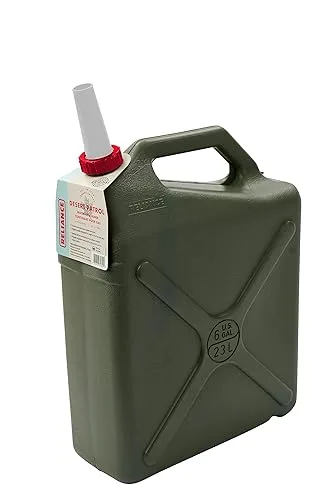
Reliance Desert Patrol 6 Gallon Rigid Water Container
About 22.7 litres per container, so two of them already cover the 36 litres a family of four needs for 72 hours. Rigid walls survive a basement better than the PET bottles that split when they freeze
Water Purification Methods
Even with stored water, you should have a backup purification method in case your supply runs out:
- Water purification tablets: Aquatabs, Puritabs or chlorine dioxide tablets are lightweight, inexpensive, and effective against bacteria, viruses and protozoa. Follow the dosage on the pack.
- Portable water filters: a LifeStraw, Sawyer Squeeze or LifeStraw Family removes bacteria and protozoa. Excellent for extended scenarios.
- Boiling: bring water to a rolling boil for at least 1 minute. The oldest and most reliable method (Health Canada and WHO guidance for Canada).
- Household bleach: 2 drops of unscented household bleach (around 5% sodium hypochlorite) per litre, wait 30 minutes. Never use scented or thickened "gel" bleach.
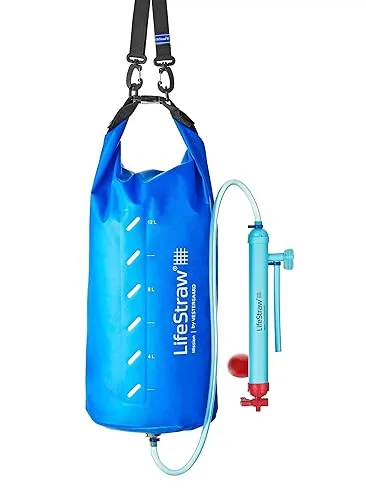
LifeStraw Mission Gravity-Fed Water Purifier, 12 L
Gravity does the work: no pumping and no power, which is exactly the situation when a boil water notice lands during an outage. Sized for a household rather than for one hiker
Special Considerations
- If you have an infant, store extra water for formula preparation — Health Canada guidance is to use freshly boiled water cooled to no less than 70 °C for powdered formula
- Keep a filter or tablets in your go-bag for evacuation scenarios
- If you have a hot water tank it can hold 150 to 270 litres of usable water — homes with a tankless (on-demand) water heater have no reservoir, so this only applies to homes with a tank
- Never drink floodwater or water from swimming pools without proper treatment
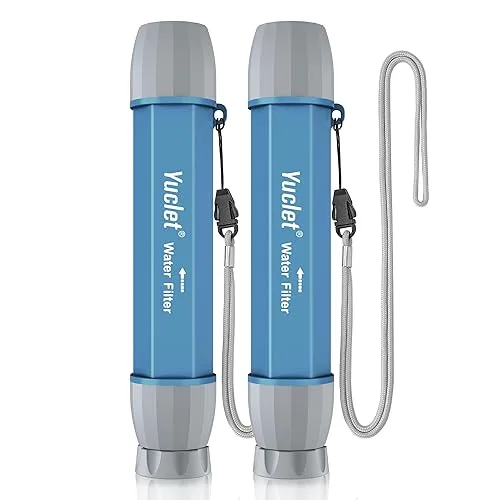
Personal Water Filter Straws (2-Pack)
One per go-bag, which is the point above about keeping a filter ready for evacuation. In a wildfire evacuation you carry a filter, not litres
Frequently asked questions
How much water do I need to store for 72 hours in Canada?
The Canada government's canada.ca/prepare campaign and the Canadian Red Cross both recommend storing enough water to manage for at least 72 hours, alongside food, a flashlight and a battery radio. As a practical baseline, plan 3 litres per person per day: 2 litres for drinking (WHO minimum) and 1 litre for cooking and basic hygiene. For a family of four that is 36 litres for 72 hours, or 84 litres for 7 days — roughly four stackable 20-litre food-grade containers. Add 0.5 litres per day for a medium dog and 1 to 2 litres extra per person during heatwaves like the June 2021 Western heat dome, when Lytton, BC reached 49.6 °C. Babies on formula need an extra 1 litre per day for safe preparation.
Recommended products
Compare prices and availability on Amazon.co.uk
What should I do during a boil water notice?
A boil water notice means your local public-health authority or municipality has detected, or strongly suspects, microbial contamination — the North Battleford, Saskatchewan outbreak in 2001 sickened thousands when Cryptosporidium got into the town water supply. Follow these steps: 1) Stop drinking unboiled water immediately, and do not use it for brushing teeth, washing salad, making ice or preparing baby formula. 2) Bring water to a rolling boil for 1 full minute, then let it cool covered (Health Canada guidance). 3) Use boiled or bottled water for all consumption until your supplier lifts the notice. 4) Bathing and showering are usually fine for adults — keep water out of mouth, eyes and open wounds. 5) Sign up to your water utility's alerts and check their live status page. Stored bottled water, a Sawyer filter or chlorine dioxide tablets give you a buffer if the tap supply is suspect.
Recommended products
Compare prices and availability on Amazon.co.uk
Is Canada tap water safe to drink after a flood?
Not automatically. After Hurricane Fiona (2022) and the November 2021 BC floods, several communities were placed under precautionary boil water notices because flooded treatment works and damaged pipes can let in sewage, agricultural run-off and soil bacteria. Until your water utility or municipality explicitly says the supply is safe: 1) Treat tap water as potentially contaminated. 2) Check your municipality's website and Public Safety Canada flood updates. 3) Boil for 1 minute, or use chlorine dioxide tablets, or run it through a 0.1-micron filter (Sawyer, LifeStraw Family). 4) Discard ice and discard any uncovered water from open containers that may have been splashed. 5) Throw away any food or formula that touched suspect water. If the pipes are physically broken, ask your municipality about bottled-water support for vulnerable households.
Recommended products
Compare prices and availability on Amazon.co.uk
How many drops of household bleach per litre to purify water?
For regular unscented household bleach (typically around 5% sodium hypochlorite), the correct dose is 2 drops per litre of clear water, or 4 drops if the water is cloudy or cold. Stir well, leave for 30 minutes covered, then sniff — you should detect a faint chlorine smell. If you cannot, repeat the dose and wait another 15 minutes. For a 20-litre container that works out to 40 drops, roughly 2 ml. Use only unscented, non-thickened bleach — never scented, "gel" or "thick" varieties, which contain detergents and surfactants that you should not drink. Bleach loses potency within 6 to 12 months of opening; keep a small bottle dated and reserved for emergency use. Chlorine dioxide tablets like Aquatabs or Puritabs are easier to dose and have a longer shelf life.
Recommended products
Compare prices and availability on Amazon.co.uk
How do I purify rainwater for drinking in Canada?
Rainwater is one of the most accessible off-grid water sources in Canada, but it is not safe to drink straight from a rain barrel. Roof run-off picks up bird droppings, dust, moss, and contaminants from old flashings and roofing materials. To make it drinkable in an emergency: 1) Collect from a clean, sloping roof using a first-flush diverter that dumps the initial dirty run-off. 2) Pre-filter through a clean cloth or coffee filter to remove debris. 3) Treat using one of three methods — boil for 1 full minute, dose with chlorine dioxide tablets per the pack instructions, or run through a 0.1-micron filter such as a Sawyer Squeeze or LifeStraw Family. 4) For maximum safety against viruses (rare in Canada rainwater but possible in flood scenarios), combine a filter with tablets. Store treated rainwater in food-grade containers in a cool, dark place. Across most of Canada there is ample rainfall over a year, so a 200-litre rain barrel fills in just a few storms.
Recommended products
Compare prices and availability on Amazon.co.uk
Verified Water and Hydration Products
Browse our curated catalogue of containers, filters, and purification tablets on Amazon.
View water products →Our recommendation
If you do only one thing, store water first: at least 3 litres per person per day for a minimum of 72 hours. It is the resource that runs out first and the hardest one to improvise safely. Use our autonomy calculator to estimate how many days your current supplies will cover, or the EmergencyKitLab Canada planner to size the exact amount your household needs.
Calculate exactly what you need
Our planner adjusts quantities to your family and situation.
Build your personalised plan